Showing posts with label Altruism. Show all posts

Wednesday, September 26, 2012

Transparently Dishonest…..

By: J Robert Giles

“The essence of lying is in deception, not in words.” - John Ruskin

Flag

Many believe that in the not too distant future, the act of deceiving a fellow human being will come to be known as “Baracking.” Although many of the words that flow so eloquently from the charmed mouth of our President are coated in thick shells of dishonesty, his actions are even more deceptive.

Set aside the horrific assault on American intellect that has been the White House’s response to the recent atrocities in the Middle East. Plenty has been written on that topic. The media won’t report it, but they are having a pretty hard time covering up the emboldened, suddenly inspired, anti-American speech being tossed about in the pit of the United Nations building this week. We’re revered as weak. Our Constitution is suddenly open to the interpretation of foreign ideology. No…..the media won’t touch that one.

For weeks we have been hearing about Mitt Romney’s tax returns. Those who oppose Mitt Romney and all the success he has had in his life seem to believe that his immense wealth will somehow come as a surprise to the rest of us. Anyway, Romney releases last year’s return as well as a summary of the last two decade’s worth of tax records. Democrats are still not happy.

In fact, I don’t believe democrats will be happy until Romney hands them something they can really sink their teeth into. That’s the way they roll. That’s how they fight. They ask their opponents to drop their cover. Democrats are the types that pick a fight with a much bigger man, then ask that man to fight without the use of his hands, feet, arms, or legs and with his eyes closed so as to make it a “fair” fight.

Much to the dismay of the liberal agenda, Mitt Romney doesn’t seem to have any of those proverbial skeletons in his closet. Instead, his returns show a level of compassion and charity most cannot fathom. The man gave away 29% of his income and the left claims it was “a trick.” Meanwhile, several of the leaders in the party known for spending YOUR money have not been so generous with their own. For example, over the last ten years, Vice President Joe Biden gave away a paltry .1% of his income to charity. Senator John Kerry, married to the Heinz Ketchup heiress…..he gave NOTHING in the last two years. Anybody hear anything about this in the media or was it trumped out by the noise of the Romney Witch-hunt?

Liberal hearts seem to bleed profusely, giving up money by the truckload when that money was earned by someone else. In their own lives however, their fat, rarely opened wallets and purses tell a different story. In fact, through analysis of Mitt Romney’s 2011 Federal Tax Return, we discover that Romney didn’t even take all of the deductions afforded him by law. Anyone think Obama or Pelosi would have missed a single deduction?

Now, since the media won’t do it…..let’s ask for some of that “transparency” Obama promised of his Administration. I realize that by now we should be taking Obama’s “promises” as seriously as Green Bay Packers’ fans take the integrity of the replacement referees, but let’s assume we have a man with at least some sense of honesty sitting in the Oval Office. Close your eyes and pretend that’s the case….

Okay, now that we’re all comfortably assembled in the land of make believe, let’s pretend that Obama was as much of an “open book” as his quivering little minion Jay Carney says he is. When asked in July if His Barackness would be making his college transcripts available to the public, Carney went off on a tangent about Donald Trump. “This is the same guy who insisted the president wasn’t born in the United States.”

That’s a discussion for another day, Mr. Carney. While there should not be lingering questions of any kind regarding the birth certificate of our President after four years in office, there seem to be many hanging over THIS President. Many experts have flat out called it a “forgery.” Many have said the same thing about his Selective Service registration form, calling it not only a forgery but a “crude” forgery.

That’s not what we asked though. The question asked of Jay Carney before he piddled himself and had to be put back in his crate, was whether or not President Barack Hussein Obama would release transcripts and records of his college days. It was demanded of George W. Bush. It was demanded of Texas Governor Rick Perry who complied only to be ridiculed for his relatively low marks. Why does His Barackness get a free pass?

This is not a “birther” issue, Mr. Carney. This is an issue of public interest. What classes did he seek out? With which professors did he align? These records would confirm the brilliance Obama so often claims to possess. Besides, who told the White House, especially their yipping little press secretary, that they get to tell us what is relevant and not? Maybe I want to see if The President of the United States of America applied to college as a citizen of the United States, or of Indonesia where he was living at the time of application. Maybe we want to see if he applied and attended as “Barack Hussein Obama” or if he was still going by his alias, Barry Soetero at the time. He attended Muslim schools in Jakarta, Indonesia as Barry Soetero. Foreigners were not admitted into Indonesian Public schools so there are some lingering questions there that America might want some closure on. Why are we not allowed to ask those questions?

This president has a propensity for downplaying and shrugging off serious matters. He has trained and commanded his loyal staff to do the same. I imagine training pads and shock collars were used, but I might be off base. Why is it suspicious when Romney releases records that don’t support your argument but Obama’s insanely expensive cover-up of his own past is dismissed as “laughable?”

It’s not laughable, Mr. President. It’s shameful. You promised us transparency but instead you have delivered paranoia, dependence, a weakened reputation around the world, dishonesty and manipulation of vitally important economic figures, and instability where we were once fortified.

Barack Obama simply must go. There is too much evidence, too many questions, and too little morale left in the wake of his orthodoxy. No matter what skewed numbers are thrown at us the fact remains that America simply doesn’t feel better off than we were four years ago. Until Jay Carney starts assigning me my feelings, I’m going to trust the ones God puts in my soul.

As always, thanks for playing!

J. Robert Giles

Friday, February 3, 2012

A Few Comparisons…..

By: J Robert Giles

CLICK HERE For Full Site

@JRobertGiles


“Wisdom and good examples are necessary at this time to rescue the political machine from the impending storm.”  - General George Washington

 US Constitution

The United States Constitution is often referred to in our sound-byte society, but how many of us have actually taken the time to learn anything beyond the quotes and phrases that further our cause? How many of us have taken the time to look at the Constitution and it’s entire history? It’s fascinating to look back at the uncertainty and the fear that surrounded our infantile country in those days and compare it to the realities of today. We’ve come so far but our country still has so many of the same questions.

Imagine if you possibly can, a countryside still soaking into it’s soil the blood of revolutionary soldiers. Brave soldiers who died defending the very idea of the world we now take for granted. There are no cars, there are no billboards. There are no highways, or airplanes, or computers, or cell-phones. There are plenty of other problems that we can’t imagine, but so much of what we take for granted today was 220 or more years from invention in those days. It was in those days that James Madison, a young Virginian with boyish features and an insatiable sense of patriotism worked tirelessly studying political theory and history. Madison’s work was not for personal entertainment, but rather as a search for solutions. Madison felt that the Articles of Confederation which ruled the land in those days, left the blossoming United States exposed to dangerous Madison inadequacies. He was determined to find solutions. The Articles left too much power in the hands of the individual states while leaving the national government weak and seemingly impotent with regard to commercial arguments between states.

The Articles of Confederation provided no taxing authority to the country itself, but instead left the power up to the states. When arguments inevitably arose, the current system left very little power in the hands of the government. States would eventually go to war with each other over commercial issues and a union of states would never exist. Madison was literally terrified with the economic future this presented to the country in which he so vehemently believed. The Continental Congress was working with a heavily depleted treasury, inflation was rampant, businesses and farms were failing, and jails were filling up with people unable to pay their escalating taxes. Depression follows debt and Madison was determined to head it off before it crippled the country he loved.

Daniel Shays was one of those men who became so enraged with the taxation issues that he started a mini-revolution. Shays had been a Captain in the Revolutionary War. He fought bravely in the Battle of Saratoga, The Battle of Lexington, and the Battle of Bunker Hill. He was wounded and forced to retire. He was never paid a dime for his service, courage, or bravery. Upon returning home he learned that he had been summoned to court over his unpaid debts that had continued to mount in his noble absence. What would later be known as “Shay’s Rebellion” ensued. Mostly farmers, tired of being exploited in order to pay British War investors, Shay’s Rebellion grew quickly. While Captain Shay’s forces were defeated Washingtonrather easily, his message reached the ears of men like James Madison and General George Washington. The poor were stretched as far as they could be stretched and were looking to relieve the pressure. An uprising against the wealthy would derail the future so many had died to deliver. Anarchy was a very real possibility and it prompted General Washington, from his Mount Vernon home to reach out to James Madison with the quote at the top of this article. That simple quote; that innocuous suggestion may have been the very words that launched the Constitution of the United States. “Wisdom and good examples are necessary at this time to rescue the political machine from the impending storm.”

In a proposal to the Virginia Assembly, James Madison recommended a meeting of delegates in September of 1786. The meeting was to take place in Annapolis, Maryland and the purpose was for all states to discuss rising problems with the current commercial environment. James Madison and a young, New York lawyer by the name of Alexander Hamilton issued a report from that meeting in Annapolis in which they urged the Continental Congress to summon delegates from all States to meet in Philadelphia to revise the Articles of Confederation. Changes were needed. That much was made abundantly clear in the Annapolis meeting. Congress didn’t jump at the idea but felt compelled enough to summon the delegates. The idea was not met with overwhelming support. Some of the era’s most prominent men publicly denounced the proposed Constitutional Convention. The State of Rhode Island refused to send any delegates and Patrick Henry said in a public statement that he “smelt a rat.” People feared Pennsylvania State House that Congress had just taken part in the invitation of it’s own overthrow. It was anarchy from within. Henry and many who shared his fear of a central form of government felt that individual state sovereignty offered more personal protection than the proposed alternative. Despite the notable absences of not only Patrick Henry but other men now considered to be founders of our country like Thomas Jefferson, John Adams, Samuel Adams, and John Hancock, the Constitutional Convention commenced in Philadelphia as planned.

It was spring in Philadelphia, and there was a buzz in the streets. There was a sense that something big was happening inside the Pennsylvania State House, which is now known as Independence Hall. The windows, normally open to provide transparency to the very people being represented inside the hallowed halls, were locked shut and covered by thick curtains. Guards stood stoically in front to keep curious passersby from interrupting the proceedings. On May 25, 1787, Robert Morris of Pennsylvania opened the Constitutional Convention. Morris had been considered the “money man” behind the revolution and he commenced the nationally anticipated convention by nominating General George Washington as President of the Constitutional Convention. The vote was unanimous. The very presence of General Washington gave instant credibility to the proceedings and provided an intense source of pride for some of the younger delegates who feared failure. Those same fears had almost kept Washington in the cozy comfort of Mount Vernon. He was torn. He was battling rheumatism, the emotions of his brother’s recent death, and the fear that no men of stature would lend their reputations to what most believed was a futile exercise. Those facts not withstanding, Washington accepted the nomination with humble grace. “I’m embarrassed to preside over such an august body. I apologize for any errors into which I may fall in the course of these deliberations.”

George Mason wrote to his son,  in the early days of the convention, “the eyes of the United States are turned upon this assembly and their expectations raised to a very anxious degree. May God grant that we may be able to gratify them, by establishing a wise and just government.” 81 year-old Benjamin Franklin never missed a session despite being so frail he had to be carried into the hall. Perhaps it was the level of importance that kept lips sealed as normally chatty politicians were prodded in pubs and taverns nearby.

On May 29, 1787, the governor of Virginia, Edmund Randolph opened debate with a long speech about the need for a strong, central government. He eloquently outlined the three branches of our government and the system by which each branch would hold the other 400px-Scene_at_the_Signing_of_the_Constitution_of_the_United_States.pngaccountable, but he went too far in his annihilation of state powers. The Virginia Plan, as it was known, was shot down but it put the course of the deliberations in their corner. It established their governmental system as a baseline. The early days of political maneuvering. The New Jersey Plan was shot down quickly as it merely suggested an amendment of the existing Articles of Confederation to allow Federal authority over taxation and commerce. It was viewed as ‘too moderate.’

Alexander Hamilton had them eating out of his hand on June 18, 1787 until he referred to British Government as the “best in the world.” His plan would have laid the groundwork for an American king. He suggested a government in which the elected President would rule as long as he was in good health and maintained his behavior. Interestingly enough, Hamilton would later become one of the most ardent supporters of the new Constitution.

The Convention itself nearly disintegrated over representation issues, but on June 29, 1787 they approved a resolution making population the basis for representation in Congress. Still the pace and frequent gridlock of the proceedings had General Washington frustrated. In July, Washington referred to opponents of a strong, central government as “narrow minded politicians under the influence of local views.” He ordered the entire delegation on a much needed, 10-day vacation. General Washington and Governor Morris rode alongside a creek that ran through the land of what was once the Valley Forge encampment. While the governor plucked trout from the pollution free waters of the creek, George Washington gazed out over the lush lands where just ten years earlier he had led freezing troops through the brutal winter of the Revolutionary War. The battles had launched the country on a course that now required some correction.

On August 6, 1787, the first draft of the Constitution was greeted with immediate conflict. The southern states feared that a New England dominated Congress would impose crippling taxes on the export industries so vital to the south. Concessions were made, and the convention moved forward. Slavery, and the regulation and taxation thereof,  was carefully and heatedly debated from both moral and economic viewpoints. Again, concessions and agreements were made and the idea that a central government, hearing and considering all sides of an issue, could serve all states spread among the delegates like fire. The future of the young country depended not on individual states, but on their ability to work together as a country.

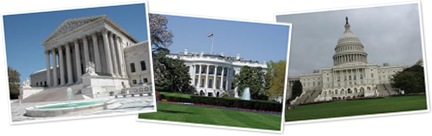
On September 17, 1787, the Constitution of the United States was signed. The Bill of Rights was outlined and promised through upcoming amendments and this promise insured the victory for the Federalists in the battle to ratify the Constitution and rid the country of the crippling rule of the Articles of Confederation.  The Constitution spelled out the system of government by which we have lived for years. The buildings pictured below were erected to symbolize the power of the people. They were never intended to be the final destination of selfish men interested only in their own agenda. These buildings were meant to represent the people who built them, not the men who work inside them.


Now, flash forward 226 years to today. There are some striking similarities, yet we live in a world that could not be more different from those seemingly impossible beginnings.Today, we face a heavily depleted treasury. The numbers by which it is depleted would surely bring a tear to the eyes of men like General Washington and James Madison. Daniel Shays would surely storm the iTents of the filthy-by-choice protesters in the Occupy Wall Street “communities.” His protest was brave. His protest brought about change because at it’s core, it was just. The idea of a strong central government laid out in those days was not the soul consuming machine under which we now live. Those men were brave and patriotic. They overcame selfish fear to bring about a greater good for a country they knew could exist. They were cautious and they acted with purpose. There was no self-centered grandstanding as is so prevalent today. There was simply direction. There was focus on future of country, not individual. There was concession and there was agreement. There was fear but in the end our government and our country gained legitimacy. What are we going to do with the choices before us in November of 2012? Changes are needed, but not just in the brilliantly conceived Executive Branch.

We the people of the United States, in order to form a more perfect union, establish Justice, insure domestic tranquility, provide for the common defence, promote the general welfare,  and secure the blessings of liberty to ourselves and our posterity, do ordain and establish this Constitution for the United States of America.”

As always, thanks for playing.


J. Robert Giles


PS: I would like to wish my grandmother, Charlene a very Happy Birthday. She was bartending at the City Tavern in Philadelphia when the delegates of the Constitutional Convention held their farewell dinner. Love you, GM!


Support Capitalism

Friday, December 16, 2011

Only at Christmas….

By: J Robert Giles

CHRISTMAS SERIES 2011 (Part 2)

CLICK HERE For Full Site 


“We Make a living by what we get, but we make a life by what we give.”  - Winston Churchill


'The Christmas Angels'

Original Story by: Susan Fahncke

Star


It was December 23, 1993. For a single mom who was going to college and supporting my children completely alone, Christmas was looking bleak. I looked around my little home, realization dawning like a slow, twisting pain. We were poor.

Our tiny house had two bedrooms, both off the living room. They were so small that my baby daughter's crib barely fit into one room, and my son's twin bed and dresser were squeezed into the other. There was no way they could share a room, so I made my bed every night on the living room floor.

The three of us shared the only closet in the house. We were snug, always only a few feet from each other, day and night. With no doors on the children's rooms, I could see and hear them at all times. It made them feel secure, and it made me feel close to them -- a blessing I wouldn't have had in other circumstances.

It was early evening, about eight o'clock. The snow was falling softly, silently, and my children were both asleep. I was wrapped in a blanket, sitting at the window, watching the powdery flakes flutter in the dimming light, when my front door vibrated with a pounding fist.

Alarmed, I wondered who would stop by unannounced on such a snowy winter night. I opened the door to find a group of strangers grinning from ear to ear, their arms laden with boxes and bags.

Confused, but finding their joyous spirit contagious, I grinned right back at them.

"Are you Susan?" The man stepped forward as he held out a box for me.

Nodding stupidly, unable to find my voice, I was sure they thought I was mentally deficient.

"These are for you." The woman thrust another box at me with a huge, beaming smile. The porch light and the snow falling behind her cast a glow over her dark hair, lending her an angelic appearance.

I looked down into her box. It was filled to the top with delicious treats, a fat turkey, and all the makings of a traditional Christmas dinner. My eyes filled with tears as the realization of why they were there washed over me.

Finally coming to my senses, I found my voice and invited them in. Following the husband were two children, staggering with the weight of their packages. The family introduced themselves and told me their packages were all gifts for my little family. This wonderful, beautiful family, who were total strangers to me, somehow knew exactly what we needed. They brought wrapped gifts for each of us, a full buffet for me to make on Christmas Day, and many "extras" that I could never afford. Visions of a beautiful, "normal" Christmas literally danced in my head. Somehow my secret wish for Christmas was materializing right in front of me. The desperate prayers of a single mom had been heard, and I knew right then that God had sent his angels my way.

My mysterious angels then handed me a white envelope, gave me another round of grins, and took turns hugging me. They wished me a Merry Christmas and disappeared into the night as suddenly as they had appeared.

Amazed and deeply touched, I looked around me at the boxes and gifts strewn at my feet and felt the ache of depression suddenly being transformed into a childlike joy. I began to cry. I cried hard, sobbing tears of the deepest gratitude. A great sense of peace filled me. The knowledge of God's love reaching into my tiny corner of the world enveloped me like a warm quilt. My heart was full. I fell to my knees amid all the boxes and offered a heartfelt prayer of thanks.

Getting to my feet, I wrapped myself in my blankets and sat once again to gaze out the window at the gently falling snow. Suddenly, I remembered the envelope. Like a child, I ripped it open and gasped at what I saw. A shower of bills flitted to the floor. Gathering them up, I began to count the five, ten, and twenty-dollar bills. As my vision blurred with tears, I counted the money, then recounted it to make sure I had it right. Sobbing again, I said it out loud: "One hundred dollars."

I looked at my children sleeping soundly, and through my tears I smiled my first happy, free-of-worry smile in a long, long time. My smile turned into a grin as I thought about tomorrow: Christmas Eve. One visit from complete strangers had magically turned a painful day into a special one that we would always remember...with happiness.

It is now several years since our Christmas angels visited. I have remarried, and our household is happy and richly blessed. Every year since that Christmas in 1993, we have chosen a family less blessed than we are. We bring them carefully selected gifts, food and treats, and as much money as we can spare. It's our way of passing on what was given to us. It's the "ripple effect" in motion. We hope that the cycle continues and that, someday, the families we share with will be able to pass it on, too.

Entry Stairs 2011

Front Room 2011

Dining Room 2011


Susan’s story is a perfect illustration of what Christmas is all about. Her story could have taken place at any time of the year and the immediate effects enjoyed by her family would have been the same. They would have been grateful for the food and money, but it wouldn’t have had the lasting impact that this season tends to deliver only to those of us willing to accept it.

Obviously, it’s loads of fun to receive gifts. Everyone loves it. I’m not going to lie and tell you that I don’t enjoy the thrill of opening up a carefully wrapped present on Christmas morning any less as an adult than I did as a child. That elated curiosity that brings a smile to your face as you reveal the contents to a waiting audience. That’s a terrific feeling no matter what the occasion, but Christmas carries a weight with which no other celebration can compete. Something about the spiritual celebration that takes place in the hearts of Christians this time of year just makes us remember the events a little more vividly. Like a movie that you truly connect with. You remember not only the lines spoken and the facial expressions displayed, but you remember your own emotional reactions to each and every scene. For most of us, that seems to be the case with Christmas as well, but can any of you truly imagine the joy Susan felt that morning when the “angels” visited her?

If you think long and hard about it, I bet you would be surprised at just how easily all of us can relate to Susan’s story. All of us have gone through that one Christmas where money was especially tight, options were bleak, and panic seemed to have you one negative event away from thinning out the population around you. We’ve all been there. The fact that you’re reading this article tells my keen sense of deduction that you survived the nightmare. For many of us, there was a shining moment, in the midst of those dark hours, that we can point to as the moment we knew we would get through it. For some, it was a generous gift from an unknown source. For others, it was the perfect gift given by your perfect person. Maybe your shining moment came when Christmas morning delivered the first smiles since the recent funeral of a much loved family member. Whatever the moment, we got through it. Susan tells a dramatic story, from the perspective of a desperate woman. What separates Susan from the people seeking handouts and expecting free luxury is that her prayer was not uttered out of self-centered greed. She had accepted the label of “poor.” Her prayer was for her children. In the midst of putting herself through college, and struggling on her own, she prayed for the ability to deliver happiness to her children. Not expensive gifts, not extravagant trinkets they would forget within a month. She prayed for the ability to deliver happiness to her own children.

And what about the family that God asked to deliver His answer to Susan’s prayer? It’s safe to assume that at some point, that family sat down and made a conscious decision to help a needy family. There’s a huge difference between needy and lazy. Susan was needy and she received blessings as such. Had she been simply lazy, such good fortune would not have come her way. Yes, she may have received the food. She may have received gifts to give to her children, but those were not the actual gifts she received that day. Those were the earthly representations of her gifts, but through her Faith she was able to see the lesson beyond the tangible objects. She was able to see that the true gift was her own ability to accept the generosity of others. Many of us don’t really see acceptance of someone else’s generosity as a gift. Sadly, it comes all to naturally in this “give it to me now – just charge it and worry about it later – do whatever feels good to you” society we live in. That seems to be all we do anymore is receive, take, and discard. Susan, like so many of what seems like an overwhelming minority, realized that she would only realize the full blessing of that generous gift if she strived to one day be on the other side of the transaction.  As much as the food and the money helped Susan and her blossoming family that year, the true gift has been in her ability to give the same joy to others. Only the recipients can determine if they gain the same experience Susan and her children gained from the generosity of strangers, but somehow Christmas allows us to believe that they will. Christmas, and the defiant birthday celebration it was intended to be, add special impact to normal events. Generosity goes further at Christmas than any other time of the year so get out there and give something. Give time, energy, or money but just make sure your experience doesn’t end upon delivery.

As always, thanks for playing!

J. Robert Giles